
The Morgan Line
The Morgan Line (or Morgan demarcation line) was a demarcation line established after the Second World War in the area of the then Julian March. It divided two military administrations: the Yugoslav in the eastern part and the Allied in the western.
It was named after the British General W. D. Morgan, Chief of Staff to Field Marshal Harold Alexander. Morgan was sent to Belgrade, where on 8 and 9 May 1945 he tried in vain in negotiations with Marshal Josip Broz Tito to achieve the withdrawal of the Yugoslav Army. The Americans and British administered the territory west of this line (Zone A of the Julian March), while the Yugoslav Army administered the territory to the east (Zone B) — until the peace conference would make a final decision on this territory. The port of Pula in Istria also came under Allied administration.
The Paris Peace Conference 1946 and the Peace Treaty 1947
From July to October 1946, representatives of twenty-one Allied nations gathered in Paris to determine the terms of peace with the defeated European states. Treaties were concluded with Italy, Hungary, Romania, Bulgaria and Finland. A distinction must be drawn: Italy was a founding member of the Axis powers and a signatory of the Tripartite Pact together with Germany and Japan, while Hungary, Romania, Bulgaria and Finland joined the Pact later with varying degrees of commitment. The treaties allowed these states to return to the international community and qualify for membership in the United Nations, while also including provisions on war reparations, minority rights and territorial adjustments. The treaties were signed on 10 February 1947 in Paris.
The key territorial changes were: Italy was required to cede to Yugoslavia the greater part of the Julian March, to Greece the Dodecanese islands, and to France the communes of La Brigue and Tende. Italy was obliged to formally recognise Albanian independence — Albania had been in personal union with the Italian monarchy since 1939. Trieste became a free territory under international administration, a status that remained in force until 1954.
Yugoslavia recovered through the treaty the lost parts of Carniola and the Littoral. The Rapallo border had in 1920 awarded to Italy the entire former Austrian Littoral and parts of Carniola, including Idrija, Vipava, Postojna, Pivka, Ilirska Bistrica and the then municipality of Bela Peč near Rateče. Under the 1947 Paris Treaty, Italy nevertheless retained part of Carniola — the municipality of Bela Peč with the valley of the Rateče — today Belopeška — lakes.
The Dispute over the Italian-Yugoslav Border
The most contentious issue in the negotiations was the border between Italy and Yugoslavia. The central role in preparing the treaties was played by the Council of Foreign Ministers of the four great powers — the United States, the Soviet Union, Great Britain and France. At its session in Paris from April to May 1946, no proposal satisfied both sides. Three proposals were on the table:
The Council of Foreign Ministers had resolved in London in September 1945 that the new border must follow the ethnic line that leaves the minimum number of people under foreign rule, taking into account the economic needs of the population concerned. On this basis, a French expert put forward a compromise line in April 1946.
The French proposal was estimated to leave only 128,000 Italians under Yugoslav rule and 115,000 Slovenes under Italian rule. The Croats gained their entire ethnic territory with Rijeka and Istria — a line that would meet most of Yugoslavia's territorial demands and leave Italy all predominantly Italian areas with a Slovenian minority. The compromise divided the Gorizia region: the town of Gorica with its immediate surroundings remained in Italy, while the larger, predominantly rural part was assigned to Yugoslavia. For Trieste and the coastal strip to Devin, internationalisation in the form of the Free Territory of Trieste was envisaged. The Paris Conference adopted the French compromise proposal by a qualified two-thirds majority, a proposal broadly consistent with the positions of the British and American governments.
The Arguments of the Parties
Italian arguments
Italy advanced historical, demographic and economic arguments. Ivanoe Bonomi, the former Italian Prime Minister who had personally participated in the negotiation and signing of the Treaty of Rapallo in 1920 as Minister of War — that is, the very border whose revision Yugoslavia was now demanding — argued before the commission that the upper Soča valley was geographically and commercially linked to the Veneto, that attaching the Julian March to Yugoslavia would hand Italian industry and hydroelectric plants to foreign control, and that the Free Territory of Trieste must have a rail connection to Central Europe that did not pass through Yugoslavia. The Western Allies argued against Yugoslavia's claim to Trieste that the city had an Italian majority whose national existence would be endangered within Yugoslavia, and that Trieste's annexation by Yugoslavia would jeopardise the functioning of the port of Trieste as an international transport hub.
At the conference itself, Italian Prime Minister Alcide De Gasperi argued that the new Italy was democratic and anti-fascist and deserved to be treated as an allied, not a defeated, state. This argument was politically understandable but historically incorrect: already on 13 July 1920 — two months before the signing of the Treaty of Rapallo and a good two years before Mussolini's seizure of power — fascist squads, with the passive complicity of the Italian authorities, burned down the Narodni dom (National Hall) in Trieste, the central symbol of Slovenian cultural and economic life in the city. By the end of 1921, 134 buildings had been burned and destroyed in the Julian March, of which no fewer than 100 were seats of Slovenian organised life — all of this before fascism formally came to power in October 1922. Violence against Slovenes was therefore not merely the fruit of fascist state policy; it ran deeper, before it, alongside it and beyond it, into the Italian attitude towards the Slovenian population of the occupied territory.
The day after the Paris Peace Treaty entered into force, on 15 September 1947, widespread attacks on Slovenian property broke out in Gorica — shops, inns, cultural centres and organisation offices. The authorities remained passive — just as they had before the fascist takeover of 1922. During the Cold War, Slovenian identity in Italy became an ideological tool: the Slovenian community in the Resian/Friulian Slovenia region was labelled a fifth column of Tito's Yugoslavia and subjected to intense denationalisation pressure, including from the paramilitary organisation Gladio.
Gladio was a secret network of armed cells established after the war by NATO as part of planning for resistance in the event of a Soviet invasion, but in practice it also operated in Italy as an instrument of pressure on communities labelled by the authorities as potentially communist. Slovenes were equated with communism after the war and treated as potential traitors and spies, even though in the great majority of cases they were loyal to the Italian state. In areas with Slovenian populations, Gladio was particularly active; simultaneously, the authorities encouraged the opening of Italian schools and nurseries and the emigration of local residents to industrial centres — with the aim of assimilating the remaining community as rapidly as possible.
Concealed post-war violence against Gorizia Slovenes · primorski.euYugoslav arguments
Yugoslavia demanded a comprehensive revision of the Rapallo border on the basis of the ethnic principle. It invoked the Slovenian settlement along the coast and in the immediate hinterland of Trieste, and the partisan contribution to the war effort. After a quarter century of Italian occupation, the local population, through inscriptions, flag-displays and rallies on the arrival of the international commission, clearly and publicly demonstrated its wish to join Yugoslavia. Tito rejected the "French line" as unacceptable and warned that its adoption would have "sad economic and still worse political and moral consequences" — the Yugoslav people would feel that after all the sacrifices for the Allied cause, they were not receiving fair treatment, while the former aggressor was being accommodated. Yugoslavia was prepared to guarantee all minority rights and to accept international supervision.
The 1919 Paris Peace Conference was built on Wilson's principle of national self-determination and the protection of minorities. Italy acquired territories with a large proportion of Slovenian and Croatian population despite the opposition of Woodrow Wilson and not on the basis of the ethnic principle, but of the secret Treaty of London of 1915. Already before the signing of the Treaty of Rapallo, the new Italian administration had banned 400 Slovenian-Croatian cultural, sporting and professional organisations and closed 488 Slovenian and Croatian primary schools. The fascist school reform of 1923 abolished Slovenian as the language of instruction in all state schools in the annexed territory. When Italy in 1946 claimed to be a democratic and anti-fascist state, it had behind it a quarter century of systematic denationalisation — and full responsibility for the aggression and war crimes of 1941–1943.
Italianization · Wikipedia · Italian war crimes · Wikipedia · Rab concentration camp · WikipediaA central Yugoslav argument was the role of Italy in the Second World War: Italy was an aggressor — for the third time (1866, 1915 and 1941). In April 1941 it attacked the Kingdom of Yugoslavia together with Germany and Hungary and established the Province of Ljubljana on the occupied Slovenian territory. During the two-year occupation, Lieutenant General Mario Roatta, through Circular 3C, ordered the shooting of hostages, the demolition of houses and entire villages, and the deportation of the Slovenian civilian population — with the explicit aim of replacing it with Italian settlers. 25,000 persons were deported from the Province of Ljubljana — 7.5% of the province's total population, one of the most drastic operations of its kind anywhere in Europe. The internees were placed in Italian concentration camps: at the Rab camp the annual mortality rate reached 18% — according to historians higher than in the Nazi camp of Buchenwald; at Gonars over 500 internees died, including 93 children. Ljubljana was the only European capital completely encircled by its occupiers with barbed wire, trenches and bunkers. Slovenian historiography has determined at least 6,400 civilian casualties under Italian occupation. Yugoslavia's request for the extradition of 1,200 Italian war criminals was refused by the Western Allies for Cold War strategic reasons; none of those responsible was ever brought to trial.
On 10 November 1943, the Allies, at Yugoslavia's request, demanded that Marshal Badoglio dismiss Roatta from his post as Chief of the General Staff. He was dismissed on 12 November. In 1944 he was arrested by the Italians on charges of war crimes; Yugoslavia's request for his extradition was refused — blocked by the British government in order to bolster the anti-communist position of the Italian government. On 5 March 1945, Roatta escaped from the Virgilio military hospital in Rome. His escape triggered a mass protest in front of the Royal Palace that escalated into riots with one fatality. A reward of one million lire was offered for Roatta's capture. Roatta fled to Spain under the protection of dictator Francisco Franco. He was convicted in absentia to life imprisonment plus one year of solitary confinement. The Italian High Court of Appeal overturned the conviction in 1948. Roatta returned to Rome in 1966 and died there on 7 January 1968 — never tried for the crimes committed against the Slovenian civilian population.
Mario Roatta · Wikipedia · The Forgotten War Crimes of Fascist Italy · History GuildThe Role of the Great Powers
The negotiations took place in the shadow of the emerging Cold War divide. The conference was marked by growing tension between East and West, with opposing views on the war legacy and the structure of international relations. The Soviet Union supported the Yugoslav claim. The United States and Great Britain supported retaining as much territory as possible with Italy, partly for strategic reasons — Italy was vital to their interests in the Mediterranean — and partly to prevent the expansion of Yugoslav, and indirectly Soviet, influence over the Adriatic. Under threat of military intervention, the Allies demanded the withdrawal of Yugoslav forces from Trieste and Gorica. The question of Trieste remained unresolved until the London Memorandum of 1954, and the definitive demarcation was confirmed by the Osimo Treaties of 1975.
The Paris Peace Treaty 1947
The Peace Treaty with Italy was signed on 10 February 1947 in Paris and entered into force on 15 September of the same year. It abolished the Rapallo regime of 1920, under which a significant part of Slovenian territory had belonged to Italy. Despite the exceptional importance of the treaty for Slovenia, half a century had to pass before the complete text was translated into Slovenian.
Territorial, political and succession clauses
Paris Peace Treaty · Ministry of Foreign Affairs of the Republic of Slovenia, Ljubljana 1997
The most important part of the Peace Treaty with Italy for Slovenia was undoubtedly the boundary provisions. These abolished the Rapallo regime of 1920, under which a considerable part of entirely Slovenian autochthonous territory had belonged to Italy. However, the Peace Treaty did not draw the full extent of the present Slovenian-Italian border.
The second set of provisions deserving particular attention is the political clauses. Through these, Italy as a defeated state renounced fascist ideology and committed to dissolving existing fascist organisations and not permitting the establishment of new organisations that would deprive people of their democratic rights.
Under the succession provisions in Annex XIV, state and quasi-state property of the Italian state — including property of the fascist party and its auxiliary organisations — passed free of charge to the successor states on a territorial basis.
The Slovenian delegation in Paris
Paris Peace Treaty · Ministry of Foreign Affairs of the Republic of Slovenia, Ljubljana 1997
Many prominent Slovenes participated in the negotiations for the conclusion of the Peace Treaty at the conference in Paris. The head of delegation was Edvard Kardelj, and one of the four deputy heads was Boris Kidrič. Delegates were Dr Aleš Bebler, Dr Drago Marušič and Dr Joža Vilfan (Secretary-General of the delegation); among the advisers were Dr Dušan Kermavner and Dr Anton Vratuša. Among the experts were Dr Lavo Čermelj, Eng. Lojze Dular, Dr Bogo Grafenauer and Dr Fran Zwitter. Janez Stanovnik served as special secretary to the head of delegation; secretaries were Dr Janvid Flere and Dr Dušan Pirjevec.

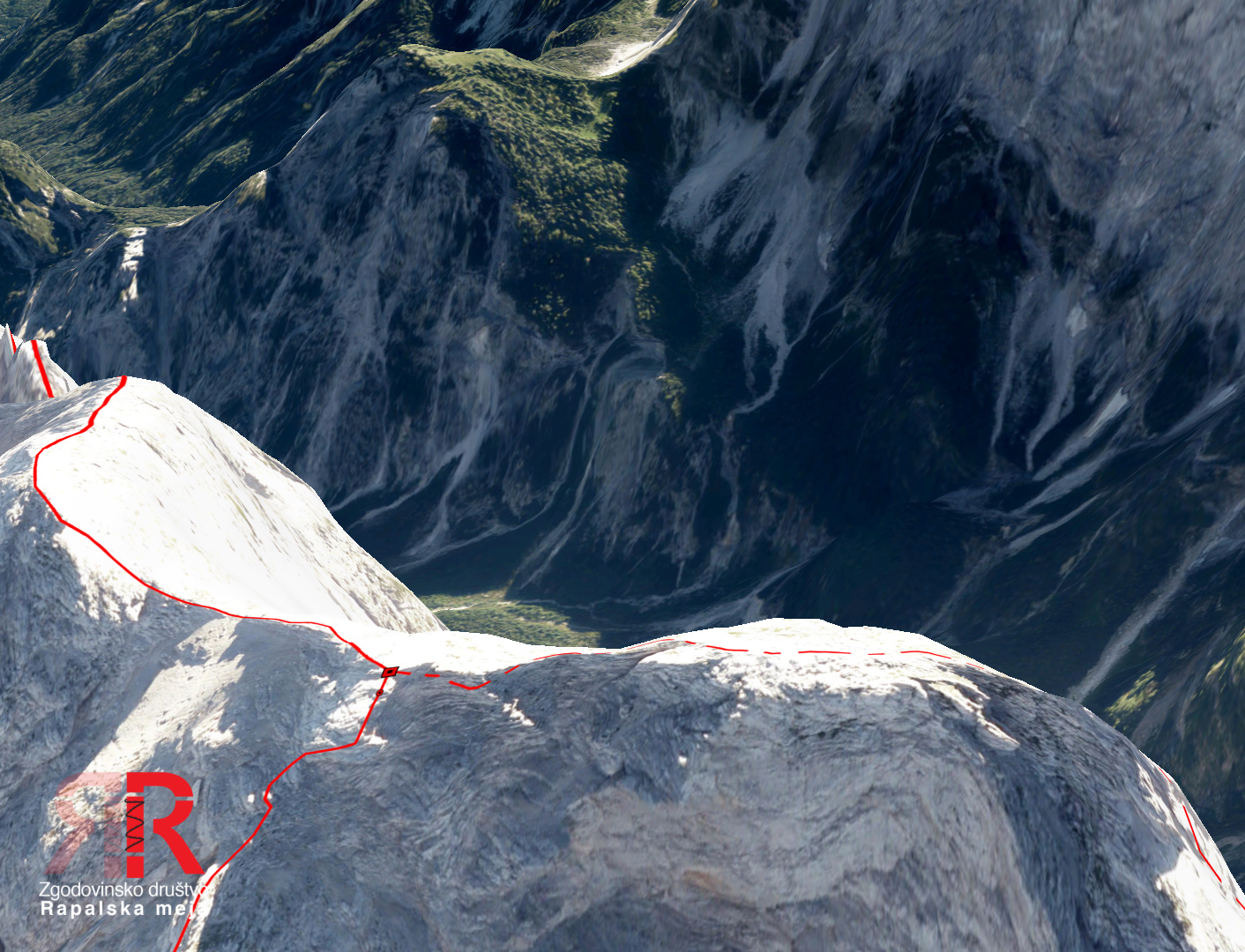
Course of the border under the treaty — Part I, Chapter I
Article 3 — the border between Italy and Yugoslavia
- the new frontier follows the line running from the junction of the frontiers of Austria, Italy and Yugoslavia as they were on 1 January 1938, and runs southwards along the frontier between Yugoslavia and Italy of 1938 to the junction of that frontier with the administrative boundary between the Italian provinces of Furlanija (Videm) and Gorica;
- from that point the line joins the said administrative boundary as far as the point situated approximately 0.5 km north of the village of Mirnik in the valley of the river Idrija;
- at that point the line leaves the administrative boundary separating the Italian provinces of Furlanija and Gorica and continues eastwards to the point situated approximately 0.5 km west of the village of Vrhovlje pri Kožbani and thence turns southwards between the valleys of the streams Karnica and Kožbanjšček to the point situated approximately 1 km south-west of the village of Fojana, after having turned so as to intersect the river Reka at a point approximately 1.5 km east of the river Idrija, and leaving to the east the road running from the village of Kožbane through Neblo to Dobrovo;
- the line continues south-eastwards running immediately south of the road between points 111 and 172, south of the road Vipolže–Uklanci through points 57 and 122, intersecting this road approximately 100 m east of point 122 and then turning northwards towards the point 350 m south-east of point 266;
- the line runs approximately 0.5 km north of the village of Števerjan, extends eastwards to Sabotin (point 610), leaving Podsabotin to the north;
- from Sabotin the line turns southwards, crosses the river Soča near Solkan, which it leaves in Yugoslavia, and runs immediately along the western side of the railway line Kanal–Dornberk to the point situated approximately 750 m south of the road Gorica–Ajševica;
- the line leaves the railway line and turns south-westwards, leaving Šempeter in Yugoslavia, together with the rest house and the road adjoining it, in Italy; it crosses approximately 700 m from the station Gorica–Sv. Marko the branch line between the above-mentioned railway and the line Zagraj–Krmin, passes round the Gorica cemetery (in Italy), runs between main road No. 55 Gorica–Trst (in Italy) and the crossroads at point 54, leaving Vrtojba and Miren in Yugoslavia, and reaches the point at point 49;
- from there the line continues southwards across the Karst plateau approximately 1 km east of main road No. 55, leaving to the east Opalje Selo and to the west Jamije;
- from the point approximately 1 km east of the village of Jamije, the line follows the administrative boundary between the provinces of Gorica and Trst to the point approximately 2 km north-east of the village of Štivan and 0.5 km north-west of point 208 — the junction of the frontiers of Yugoslavia, Italy and the Free Territory of Trieste.
Article 4 — the border between Italy and the Free Territory of Trieste
- the boundary line runs from the junction of the frontiers of Yugoslavia, Italy and the FTT at point 208 and turns south-westwards to a point on main road No. 14, approximately 1 km north-west of the crossroads of main roads Nos. 55 and 14, linking Gorica and Tržič with the city of Trst respectively;
- the line turns southwards to a point in the Pancanski zaliv equidistant from Rt Zdobe at the mouth of the river Soča and the Devinski grad near Devin, approximately 3.3 km south of the point where it leaves the coast — approximately 2 km north-west of Devin;
- the line extends to the open sea, equidistant from the Italian coast and the coast of the Free Territory of Trieste.
Boundary commissions
The precise course of the frontiers established in Articles 3 and 4 shall be determined on the spot by commissions composed of representatives of the two governments concerned. The commissions shall begin work immediately after the treaty enters into force and complete it within six months. Questions on which the commissions cannot agree shall be referred to the Ambassadors of the Soviet Union, the United Kingdom, the United States and France in Rome. The costs of the commissions shall be borne equally by the two governments concerned.
The commissions are permitted to deviate by 0.5 km from the specified line in order to adapt the boundary to local geographical and economic conditions — provided that in so doing they do not affect the sovereignty over any locality with more than 500 inhabitants, any railway line, any main road or any water or electricity supply.
- Paris Peace Treaty: complete translated text of the Peace Treaty with Italy, signed in Paris on 10 February 1947, and facsimile cartographic representation of the treaty-defined borders between Italy, the FPRY and the FTT. Ljubljana: Ministry of Foreign Affairs of the Republic of Slovenia, 1997. ↗ PDF
- ↗ Paris Peace Treaty · Arhiv Nove Gorice
- ↗ Paris Peace Treaties, 1947 · Encyclopaedia Britannica
- ↗ Paris Peace Conference 1946 · EBSCO Research Starters
- ↗ FRUS 1946, Vol. II, doc. 307 — Council of Foreign Ministers · history.state.gov
- ↗ FRUS 1946, Vol. III, doc. 121 — Paris Conference · history.state.gov
- ↗ FRUS 1946, Vol. II, doc. 188 — Italian territorial questions · history.state.gov
- ↗ Negotiations for the peace treaty · Sistory
- ↗ Ivanoe Bonomi · Encyclopaedia Britannica
- ↗ Treaty of Peace with Italy, 1947 · Military History Wiki
- ↗ Concealed post-war violence against Gorizia Slovenes · primorski.eu
- ↗ 100 years after the rise of fascism — the Slovenian minority concerned again · RTV SLO
- ↗ Mussolini and Trieste 1918 · Kritik.si
- ↗ Slovenian community in Italy · Wikipedia
- ↗ Slavia Friulana (Venetian Slovenia) · Wikipedia
- ↗ The Slovenes in Italy and Slovenian Independence · ResearchGate
- ↗ Italian war crimes · Wikipedia
- ↗ World War II in the Slovene Lands · Wikipedia
- ↗ Rab concentration camp · Wikipedia
- ↗ Gonars concentration camp · Wikipedia
- ↗ Italianization · Wikipedia
- ↗ The Forgotten War Crimes of Fascist Italy · History Guild
- ↗ Yugoslav statement to Paris Conference (Simić) · history.state.gov