
The Alpine Wall and the Rupnik Line — defensive fortification systems along the Rapallo border between 1927 and 1941
Alpine Wall
The construction of permanent defensive works on the Apennine Peninsula is by no means a particularly unusual phenomenon; throughout history, powerful barriers blocking the mountain passes and valleys had sealed the approach to the Apennine Peninsula across the Alps. In the Italian Army, when planning new and more modern fortifications after the First World War, the school that prevailed advocated the established practice of fortifying individual points, with the intervening gaps in the mostly mountainous terrain to be controlled by a network of barracks and access roads that would allow the rapid deployment of troops.
Matjaž Bizjak presents documents placing the start of the fortification works in 1927, when the Commission for Fortification was established, but managing such an extensive project proved too great an undertaking. Responsibility was therefore delegated to the individual army corps in the border areas. The project of fortifying all of Italy's borders — not only the eastern one along the Rapallo border — was named Vallo Alpino — the Alpine Wall. The land border alone, running from the Ligurian Sea to the Adriatic along the arc of the Alps, was 1,850 kilometres long. The section along the Rapallo border, in the area occupied by Italy from 1918 onwards and formally annexed under the Treaty of Rapallo, measured 250 kilometres and was extremely varied and rugged in relief — it began with the Alps, continued through hills and valleys and ended with the karst plateaux and the descent to the Adriatic coast at Rijeka.
Remains of the Alpine Wall — or more precisely, remnants of the fortification works and accompanying infrastructure — are numerous along the former border. Bizjak is again the source who records the official completion of the Alpine Wall in 1942. Numerous roads, civilian and military buildings, and both permanent and temporary defensive works criss-cross western Slovenia. After the Second World War, the Republic of Italy continued construction of the Alpine Wall when, due to the return of part of the territory of the former Austria-Hungary to Yugoslavia, new fortifications began to be built along the present Slovenian-Italian border.
DEFENCE CONCEPT AND SPATIAL DISTRIBUTION
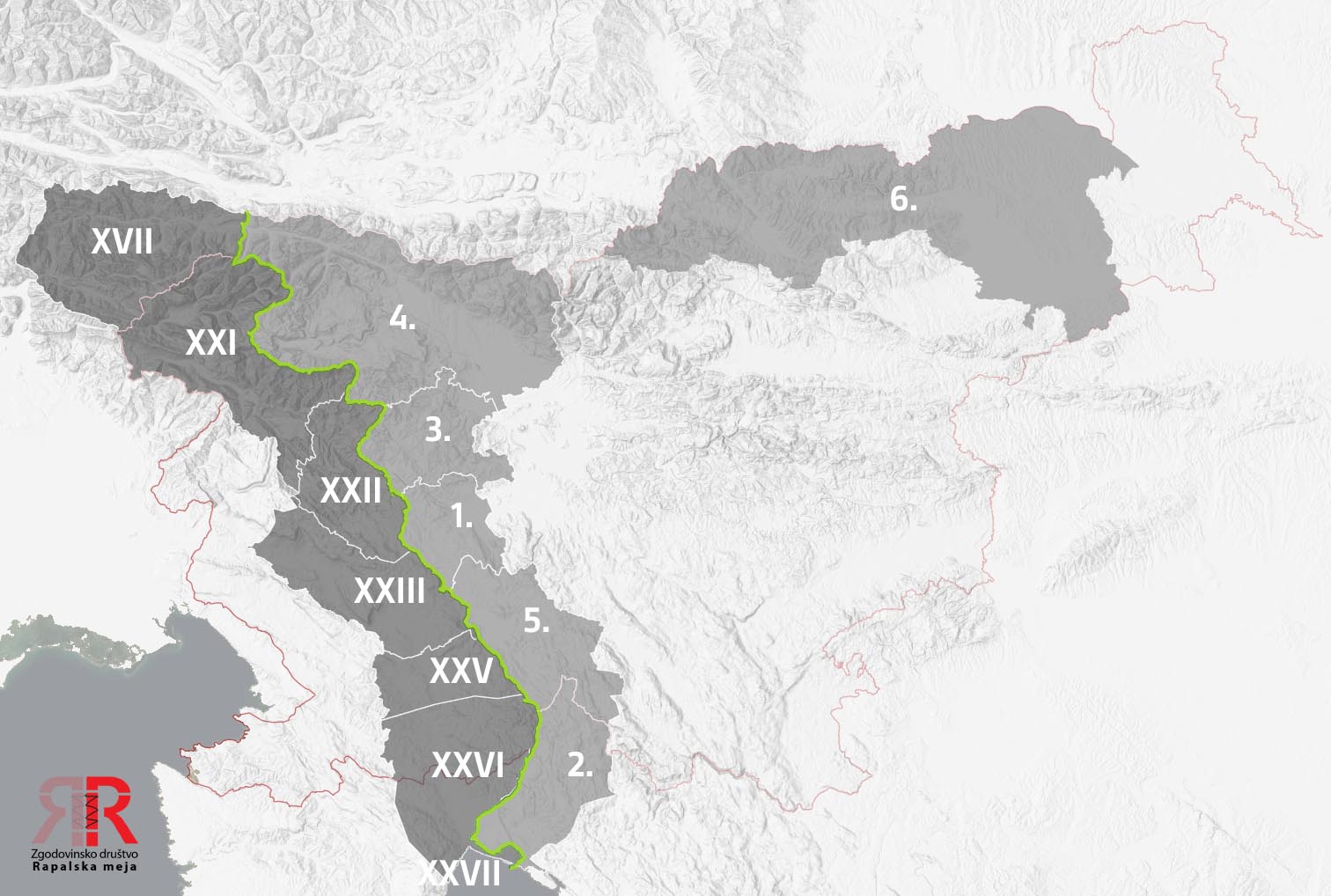
Relying on the Alpine arc, an area of pronounced high mountains that was difficult to cross, allowed a funnel-shaped approach to defence, in which it was only necessary to fortify the valley passes or saddles. The Italians thus developed a concept of individual resistance centres which, within a smaller area, made up a defensive group — a self-contained unit of permanent and temporary defensive works. The more open the terrain and the more numerous the passages, the less gap there was between the defensive groups. Italy also divided the jurisdictional areas of the army corps into border sections that formed sectors and sub-sectors of the Alpine Wall. In less than a decade, the sections changed several times; the final number of seven sectors along the Rapallo border was reached in 1939.
PREPARATIONS FOR CONSTRUCTION OF THE ALPINE WALL
The decision to construct permanent defensive works was by no means the only military construction project Italy undertook along its new state border. After the formal annexation of the territory in 1921, it began renovating existing barracks; as early as 1922 it established a network of finance guard barracks along the border; from 1924 systematic construction of military access roads began and two larger barracks were completed in Postojna and Ilirska Bistrica; from 1927 an extensive overhaul of the road network began along with construction of barracks in towns and mountain barracks below Triglav, Bogatin and Možic. Most investments in the mountainous and hilly terrain were intended for the Alpini corps, who after the end of the First World War had become the primary defenders of the mountain borders. The construction machinery was thus already in full swing when the competent army corps between 1928 and 1930 drew up outlines of the proposed defensive groups and sent them to the Fortification Office at Supreme Command. The latter issued in 1931 the first of the circulars by which it prescribed uniform guidelines to the army corps for drawing up actual plans. Along the Rapallo border the process of drafting outlines began (at least) in 1929, since reports about it already exist from 1930. On 6 January 1931 guidelines for planning defensive works in mountain terrain were received (Circular No. 200), and already on 5 March of the same year guidelines for planning along the forested and less mountainous eastern border (Circular No. 800). From this it is evident that along the former Rapallo border we have unique remains of the Alpine Wall that differ from the rest of the Alpine Wall both in their placement in the landscape, construction and integration into the defensive belt.
CONSTRUCTION OF THE ALPINE WALL
Planning and siting in the landscape was followed by a land survey procedure, which formed the basis for the expropriation of landowners through the courts. The procedure was the same everywhere the Alpine Wall was built, and all citizens were compensated equally, even those of Slovenian origin or even Yugoslav citizens who had become holders of land on both sides of the Rapallo border. Construction of resistance centres, observation posts, artillery positions and other defensive works along the Rapallo border began in 1933 and broadly lasted until 1936, when most of the originally designed fortifications were handed over for use. A characteristic of the Alpine Wall is that even after 1936 they did not merely build new defensive works but also updated, expanded and interconnected existing ones. The structures of the Alpine Wall thus represent a changing process in which one can identify the guidelines of different circulars.
During construction, a process of forming a new branch of the army was also underway. On 24 March 1934 a regulation was issued on the formation of a special military unit trained for the static protection of the border. All the technical units already responsible for the defensive system were incorporated into it, and detachments of artillery and infantry were added, which gradually took over tasks from the Alpini and took charge of managing the structures. The annexation of Austria to Germany, the obvious preparations for a new European war and the revised guidelines for the construction of permanent defensive works strengthened the importance of active defence, so that the border guard only became an independent corps by royal decree No. 833 of 28 April 1937. The border guard thus became a parallel system, formally still under the command of the army corps. Along the Rapallo border were the XIV, XI and V Army Corps, with their seats in Treviso, Udine and Trieste.
In 1937 a new circular (No. 7000) addressed the empty intermediate zones of the Alpine Wall, which they began to fortify with concrete field defensive works, adding smaller resistance centres to existing defensive groups.
Particularly notorious is the last circular, issued already during the Second World War but before the Italian attack on Yugoslavia. The idea behind defensive works is to hold up an attacker long enough for larger military units to assemble in the rear and organise a defence. Because of the mobilisation and concentration of troops as part of the offensive preparations of the aggressor, the defensive works were used for the purpose of housing troops who would launch the attack from the safe shelter of the fortifications.
BUILDERS OF THE ALPINE WALL
The construction of permanent defensive works was carried out by construction companies with civilian labour on the basis of public tenders. Projects were divided according to difficulty and importance — this determined whether companies were allowed to employ local labour — the key question here being citizens of Slovenian origin, whom the Italian authorities and security services regarded as a security risk. Most of the workforce was recruited by companies from the southern provinces of Italy — partly because it was cheaper. The army, as the client, imposed strict rules on the appearance of construction sites — they had to be screened with curtains that prevented observation of activities. A high standard was also required of companies in the accommodation of workers — who mostly lived in purpose-built barracks. For other construction works, such as roads, the employment of Slovenes was also permitted, and according to testimonies those with good connections and guarantees could also participate in the construction of defensive works. Every earnings opportunity was after all still very welcome.
Rupnik Line
Before the Second World War, the Kingdom of Yugoslavia was constructing a large permanent defensive fortification system to counter external military threats, the section of which along the western border with Italy and later along the border with Germany and Hungary was officially named the Western Front and later also the Northern Front.
This part of the fortification system in what was then the Drava Banovina — present-day Slovenia — acquired, already during its construction, the name of the Slovenian-born General Leon Rupnik, Chief of Staff for Fortification between 1938 and 1941. The Rupnik Line, despite individual attempts at defence against German attackers, never served its original purpose of defence against Italy, as the army of the Kingdom of Yugoslavia withdrew from it before the Italian attack began in 1941.
Its remains can be seen to this day – particularly well preserved between Begunje na Gorenjskem and the Poljane valley and in Carinthia and Styria. There are few remains of the Rupnik Line between the Poljane valley and Babno polje, as the Italian army systematically destroyed them during the occupation of the Province of Ljubljana.
SITING IN THE LANDSCAPE
The Yugoslav Army deliberately chose the mountainous, hilly and more difficult terrain of western Slovenia for the construction of fortified structures, through which the Rapallo border had run since 1920. This area is characterised by smaller and narrower river valleys, a weaker road network and the karst landscape of the karst plateaux. It was anticipated that Italy would most easily cross the border in the direction of Postojna–Logatec–Ljubljana and at Rijeka. The area was therefore divided into five sectors and numbered according to their importance.
After the German annexation of Austria, a fortification section No. 6 was established between Črna na Koroškem and the river Mura and the area of fortification section No. 4 along the northern border was extended all the way to Jezersko. This also secured the more important passes on the northern border.
Individual larger self-contained stretches of the front were formed by fortified zones, which could, depending on geographical conditions or operational defence requirements, consist of several fortified belts (e.g. a forward outpost belt, a main defensive belt, a rear belt). An individual fortified belt was represented by a larger number of fortification structures across a wider area. These structures, in order to meet expected tactical requirements or to provide adequate defensive strength, could in a given area be placed in several lines (usually a larger number of more uniform types of structures of lesser resistance and firepower) or in just one line (in which case there was a combined deployment of structures of greater resistance and firepower), while the spaces between structures were intended for elements of operational military units to which the individual fortified zones were subordinated.
PREPARATIONS FOR CONSTRUCTION OF THE RUPNIK LINE
France, then a world power and the great victor of the First World War, had already proposed to the Kingdom of Yugoslavia in 1926, with the aim of blocking Italian expansionist ambitions on the eastern Adriatic coast, the protection of the Yugoslav-Italian or Rapallo border with a system of permanent fortification, i.e. fortification works and fortified structures. But from the first ideas about constructing a permanent defensive system in the second half of the 1920s to the actual start of work, almost a decade had to pass; this of course does not mean that the Royal Yugoslav Army was not addressing the question of fortifying field positions, on which e.g. Practical Instructions for Arranging Positions and Solving Tactical-Fortification Tasks were also published in 1930. But tasks directly related to securing the borders, preparations for surveying and mapping the terrain, only got under way in 1935 (apart from some preparatory works in 1927 along the Italian border near Vrhnika). Based on these data, by 1938 the positioning of command positions, communications, observation posts, depots, shelters and other structures of the fortified zones followed — including the largest resistance points and numerous smaller fortification structures. During this period construction also began of numerous (access) roads, narrow-gauge construction railways, electrical connections, workers' accommodation and the opening of quarries.
CONSTRUCTION OF THE RUPNIK LINE
Only in 1938 was the Headquarters for Fortification — or more precisely for actual construction of defensive works — established, headed in Ljubljana by General Leon Rupnik. According to the plans, the bulk of the work was to be completed by 1946, i.e. over the following eight years.
Actual construction of individual resistance points and smaller fortification structures only proceeded from 1938 onwards, but already in December of that year the Yugoslav Army, in light of the annexation of Austria and the occupation of Czechoslovakia, designated Germany as the primary and most dangerous adversary and redirected the bulk of resources from the Western to the Northern Front. As a consequence, the original plans for the largest and most impressive ridge fortifications along the western border remained unrealised.
But the reallocation of resources was by far not the greatest problem – the designers of the fortifications, who had looked to their French and Czechoslovak colleagues as models, realised that the same approach was simply not possible in Yugoslavia. Individual fortification elements such as steel armour cupolas and weapons, especially anti-tank guns, could not be manufactured in Yugoslavia, and the production lines of both allies were fully loaded with their own needs. All of this led in 1940 to a drastic simplification of plans and the abandonment of the construction of more demanding structures in the fortified zones and their replacement with a larger number of simpler positions — also distributed across several fortified belts — of reinforced field fortification structures (ranging from the simpler rifle-machine-gun concrete nests and reinforced concrete machine-gun nests, through intermediate standard structures, to a smaller number of heavy infantry structures).
Fortification in the last year and a half before the joint attack of Germany, Italy, Hungary and Bulgaria on Yugoslavia proceeded not only along the borders but also in the interior, as the command was convinced that the failure of the defence of Poland and France had been based on the absence of positions in the interior of the country. Yugoslavia sought to prevent this by constructing a second line at Zagreb and Karlovac and a third line along the rivers Una and Vrbas. In the intermediate space, engineers had to prepare in advance everything necessary for the maximum possible demolition of structures, with emphasis on bridges, tunnels and overpasses.
BUILDERS OF THE RUPNIK LINE
For the construction, special construction teams were assembled, which in 1935 numbered around 15,000 people, distributed across twelve sections. Five operated along the Italian border, one on the Austrian, and six on the Hungarian border – at this time they were building primarily infrastructure. From 1939 the number grew to around 40,000, as resistance points and individual fortification structures were also being built during this period. When Germany attacked Poland on 1 September 1939, the army took over the construction and reinforced the construction force with conscripts and mobilised reservists.
The assumption that the work reached its peak immediately before the outbreak of war in Europe is confirmed by publications in the daily press, in publicly issued laws and in circulars from municipal archives. Although the Finance Act for 1937/38 had made it possible to employ engineering specialists for the needs of the construction works, the Headquarters for Fortification published the most requests and tenders for materials and equipment needed in its work and constructions in the Traders' Gazette in 1939.
It is generally accepted that the absolute peak of construction activity in the Kingdom of Yugoslavia was reached at the turn of 1940 into 1941. At that time, more than 60,000 soldiers and civilians were participating in the construction of fortification structures across all twelve sections in the country.
Similarities and differences
Both systems had their beginnings in the appointment of commissions that would comprehensively address the question of fortifying the state border. Italy abandoned this approach within just two years and delegated fortification to the army corps that administered the territory along the state border. On the basis of their proposals, Supreme Command then drew up uniform guidelines, but at the same time left all further decisions, the choice of locations and the design of individual defensive works to the corps. Yugoslavia, on the other hand, opted for centrally managed planning, which was reflected primarily in the universal approach to the construction and design of defensive works. Unlike Italy, which developed the typology of fortifications and protective steel parts itself, Yugoslavia relied on the French–Czechoslovak school and primarily the production of protective parts and armaments. Only after the breakdown of trade cooperation was it forced to independently address the production of steel parts and construction iron. The most orders were placed with the ironworks at Jesenice, but the technology was too modest compared with Czechoslovakia.
The fundamental difference between the two systems is also the protection of personnel. Yugoslavia, which had initially planned extensive defensive works with large underground spaces, had to adapt its construction to real conditions and in a short time build hundreds, even thousands of smaller, simpler structures, without underground logistical sections that would simultaneously protect and provide living conditions for the garrison. Italy, on the other hand, approached the fortification of exposed passes, but there already from the start built structures that even on the flat karst surface had underground logistical sections. The system was over the years densified and connected through a multitude of temporary field fortifications.
Sources and literature
Alpine Wall
Rupnik Line
Zgodovinsko društvo Rapalska meja
Typology of Fortification Objects
The typology of fortification objects of the Royal Yugoslav Army was prepared by Aleš Žlebnik and Matevž Grošelj. The document is in PDF format and is freely available for download.