
Financial Control, Regia Guardia di Finanza, carabinieri, Grenčarji, Regio Esercito and MVSN along the Rapallo border
Border Services of the Kingdom of Yugoslavia
Financial Control

The Financial Control was established by a decree of Crown Prince Aleksandar on 1 January 1921. It merged the financial services of all the united states and became the principal agent of border surveillance on the Rapallo border. At its peak it employed nearly 1,400 personnel on Slovenian territory. Its members held full powers to use weapons and to arrest persons.
Its predecessors go back to the Austrian Empire, where in 1843 the border guard and the revenue guard were merged into the Imperial-Royal Financial Guard (K.u.k. Finanzwache).
Customs Service
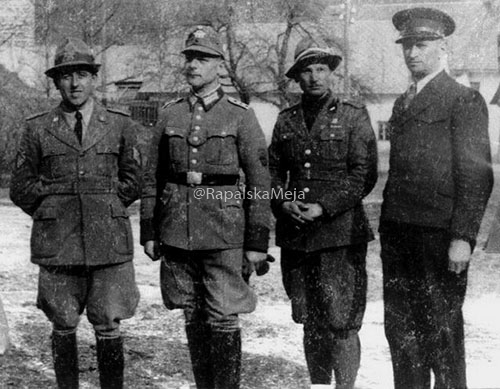
The Customs Service of the Kingdom of Yugoslavia began in 1919 with the establishment of 85 customs offices across the entire Slovenian territory. Unlike the Financial Control, it was better paid, yet its structure in Slovenia employed only 30% Slovenes.
By 1935 it employed 120 customs officers in 51 customs offices in the Slovenian area. Customs officers were not responsible for surveillance along the border itself, but only for the clearance of goods at border crossing points.
Royal Yugoslav Army
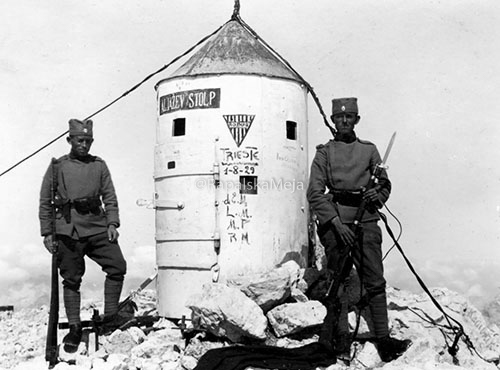
Within the army of the Kingdom of SHS there existed a corps of border military — the Grenčarji, also known as Graničarji. Formally part of the conscript system, they patrolled the border to ensure security against attack, prevent the entry of dangerous groups and apprehend illegal crossers.
The Rapallo border was considered one of the safer frontiers of the kingdom, and many decorated soldiers were posted here. They were billeted in small wooden barracks (karaule), built a few kilometres apart.
Border Services of the Kingdom of Italy
Regia Guardia di Finanza

Founded in 1866, it was the principal agent of surveillance on the Italian side of the border. It fell under two ministries — in peacetime under the Finance Ministry, in wartime it would have passed to the Defence Ministry. No other service held the legal authority to deprive persons or goods of liberty.
The Finanzieri were generally better received by the Slovenian population than other Italian services, as evidenced by the frequent marriages with Slovenian women.
Carabinieri Reali and Public Security

The Royal Carabinieri were responsible for civilian duties and maintained posts in nearly every locality. For border control they were stationed at Category 1 border crossings.
The Public Security (Pubblica Sicurezza) — today the Polizia di Stato — oversaw the operation of border crossings and the coordination of services. Its offices were located in Tolmin, Podbrdo and Idrija.
Regio Esercito and Milizia Confinaria

The Regio Esercito (Royal Army) protected state territory and had no direct jurisdiction along the border line. By royal decree of 24 March 1934 a special unit was established — the Guardia alla Frontiera (GAF) — which assumed static border protection; it was formally constituted as an independent corps by royal decree of 28 April 1937.
Within the fascist paramilitary organisation MVSN (Milizia Volontaria per la Sicurezza Nazionale), the Milizia Confinaria (MC) was formally established on 9 January 1927 — a branch charged exclusively with the political surveillance of the border zone. Among the Slovenian population it was the most hated of all services — it acted aggressively in the Italianisation campaign and not merely in border surveillance. Whereas the Finanzieri prosecuted smuggling with bureaucratic detachment, the militia acted out of ideological conviction.