
From Napoleon to the return under Austria
The Austrian Littoral did not emerge from nothing. Its shape and territorial extent were the result of protracted reorganisations that began with Napoleon's intervention in the heart of Central Europe. When France, following its victory at Wagram in 1809, forcibly took the lands along the Adriatic and its hinterland from Austria, Napoleon formed from them the Illyrian Provinces (Provinces Illyriennes) — a unified administration centred on Ljubljana, headed by a governor-general.
The Provinces united Carniola, Carinthia (western part), Gorizia with Gradisca, Trieste, a large part of the Croatian Military Frontier and part of Dalmatia. It was a short-lived arrangement: after Napoleon's defeat, Austria occupied these territories in 1813–1814, while the Congress of Vienna (1814–1815) formally confirmed the return to Habsburg authority.

Kingdom of Illyria (1816–1849)
Upon the return to Habsburg authority, Vienna did not simply restore the pre-Napoleonic order. Emperor Francis I in 1816 formed a new administrative entity called the Kingdom of Illyria (Königreich Illyrien). It arose as an indirect consequence of the abolition of the Illyrian Provinces — since Austria had to reorganise the recently acquired territory within the framework of the Holy Alliance and the Congress of Vienna. The Illyrian Provinces had thus shaped the awareness of a common "Illyrian" identity of this space, which Vienna transferred to the name of the new arrangement.
The Kingdom of Illyria comprised:
- Carniola (Duchy of Carniola)
- Carinthia (Duchy of Carinthia)
- Gorizia and Gradisca (County of Gorizia)
- Trieste with its surroundings (free royal city)
- Istria
It was governed by the emperor's deputy (Landespräsident) with a supervisory committee, but without provincial diets — a bureaucratic centralisation in the Metternich spirit. The Kingdom of Illyria was thus an administrative unit within the empire, not a political entity with its own legislative authority.

Littoral
prov. diets
Austria-Hungary
New order after 1849
The revolutionary year of 1848 shook the Habsburg Empire and swept away the existing Metternich-bureaucratic system. When Emperor Francis Joseph I proclaimed the imposed constitution (oktroyierte Verfassung) in March 1849, he thereby formally abolished the Kingdom of Illyria and established a new order of crown lands, in which the lands became more directly accountable to Vienna.
The County of Gorizia and Gradisca, Trieste and Istria were closely interconnected lands along the Adriatic. Vienna therefore united them into a common administrative unit, which in 1849 it named the Austrian Littoral (Österreichisches Küstenland). This was not a single crown land, but a collective administrative framework of three historically distinct lands, united under a common lieutenancy in Trieste.
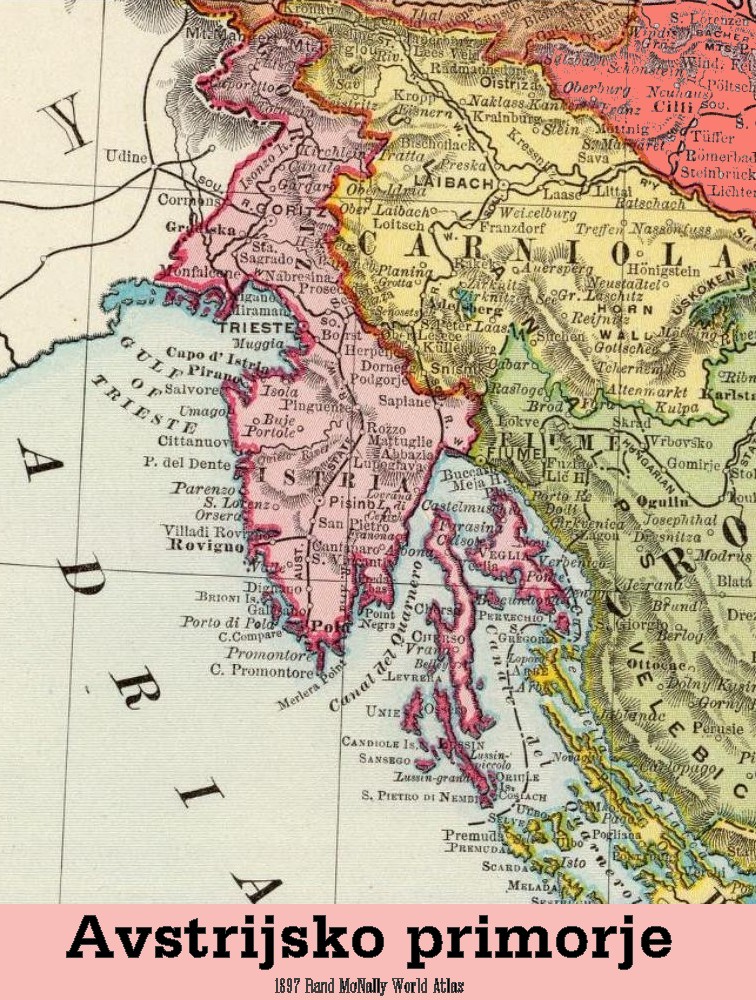
The formation of the Austrian Littoral was partly also a response to the Hungarian strategy for access to the sea. From the mid-18th century, Rijeka (Fiume) had been a subject of dispute between Croatia and Hungary. Empress Maria Theresa formally annexed Rijeka to Croatia in 1776, but Joseph II included it among the direct Habsburg possessions. With the Croatian–Hungarian Settlement of 1868 — one year after the Austro-Hungarian Compromise — Rijeka received the status of corpus separatum: a territory under the direct authority of Budapest, separate from both the Croatian lands and Cisleithania. Hungary thereby acquired its own Adriatic port and an independent route to the sea.
The Austrian Littoral in this geostrategic context functioned as a counterweight to Hungarian maritime ambitions. Trieste — the largest port of the Habsburg Monarchy and a direct imperial possession — ensured that the Austrian half was not dependent on Hungary for access to the Adriatic. The competition between the port of Trieste (Austrian) and Rijeka (Hungarian) defined the entire late Habsburg period: both built infrastructure, attracted investment and competed for traffic flows between the interior and the Mediterranean. The rich mercantile maritime heritage of both ports was a cause of Italian territorial claims.
Three parts, one Littoral
The Austrian Littoral was composed of the common lieutenancy in Trieste, which oversaw three lands with separate provincial diets, their own internal administration and different historical traditions. The common body was the Littoral Diet (Küstenländischer Landtag), established in 1861 by the February Patent.
Languages: Slovenian, Friulian and Italian
Character: on the Isonzo plain a strong Friulian and Italian-speaking community. The remainder a predominantly agricultural land with a strong Slovenian majority in the hinterland; Gorizia as the cultural centre of Slovenes.
Languages: Italian, Slovenian
Character: the largest and most important port of Austria-Hungary; directly under Vienna; the Slovenian hinterland comprised a third of the city's population.
Languages: Croatian, Slovenian and Italian
Character: peninsula with a mixed Slavic-Romance population; Croatian and Slovenian majority in the interior and north.
Ethnic composition according to the 1910 census
February Patent and provincial diets (1861)
With the February Patent (1861), Francis Joseph I introduced a constitutional system with provincial diets in each crown land. The Littoral received a common Littoral Diet in Trieste (composed of deputies from all three lands), while each land retained its own provincial diet for internal affairs. This dual arrangement was a compromise between centralisation and provincial particularity.
The Slovenian and Croatian population was systematically underrepresented in these diets — the curial electoral system favoured the urban (predominantly Romance-speaking) bourgeoisie and large landowners. Struggles for the equality of Slavic languages in administration, the courts and schooling became a constant feature of Littoral politics in the second half of the 19th and the early 20th century.
Why the curial system favoured the urban bourgeoisie
The Habsburg provincial diets were not elected on the principle of "one person, one vote". The electoral system was divided into four curiae — classes of voters with unequal voting weights. Each class had a predetermined number of seats regardless of how many people voted within it:
- Large landowners — owners of large estates whose annual income exceeded a certain threshold. In the Littoral these were predominantly wealthy owners who spoke German or Italian by virtue of their social position or noble origin.
- Chamber of Commerce (Handelskammer) — represented owners of larger businesses and factories. Larger entrepreneurs were again predominantly German or Italian speakers due to their social position.
- Urban residents — in Trieste, Gorizia and the coastal towns, the bourgeois layer used German or Italian by virtue of its social position.
- Rural communes — in villages and in the countryside, Slovenian- and Croatian-speaking communities predominated. Yet this class had by far the fewest seats in the diet — despite comprising the majority of the population.
The result: Gorizia's Slovenes represented almost 60 % of the population, yet won a minority of seats in the provincial diet. In Trieste, the number of Slavic-speaking deputies was even smaller relative to their share of the city's population. The system was legal — but not just.
Chronology
Rights and achievements of the Slovenian community
Despite the curial electoral system that politically favoured the Italian-speaking bourgeoisie, the Slovenian community in the Littoral in the second half of the 19th and the early 20th century built a dense network of cultural, educational, economic and political institutions. When the Italian army occupied the Littoral in November 1918, it did not occupy an Italian-speaking land, as the Risorgimento had proclaimed and as soldiers had been promised — it occupied a linguistically and ethnically heterogeneous area. The Romance population predominated along the land border with Italy and in some coastal towns, while the interior was almost entirely Slovenian. It did not occupy an empty land — it occupied a living national organism with a developed self-governing structure.
Reading rooms — cradle of the national revival
The reading room movement in the Littoral began in 1861 in Trieste — the same year as the February Patent that granted the lands a constitution. Reading rooms were the first institutions where the Slovenian bourgeoisie publicly gathered, read Slovenian words and debated national affairs. They spread with extraordinary speed: by 1866 there were already 26 reading rooms in the Gorizia region, 12 in the Trieste region and 2 in Slovenian Istria. The Littoral was thus the leading area in all Slovenian lands in terms of the number of reading rooms.
Tabor assemblies and the demand for United Slovenia
In the wave of the Tabor assembly movement that between 1868 and 1871 mobilised Slovenes across Austria-Hungary, the assemblies also reached the Littoral. The Tabor at Sežana (29 May 1870) and the Tabor at Kastav (21 May 1871) each attracted approximately 6,000 participants. The demands were uniform: United Slovenia as a single crown land unit with official Slovenian language, greater self-government and equality in schooling and administration.
Slovenian journalism and publishing
The press was the backbone of national life. In the Gorizia region the most important newspaper was Soča, which began publication in 1871 and remained the central tribune of Gorizia's Slovenes until the First World War. Andrej Gabršček (1864–1938) in 1893 founded the Goriška Printing House in Gorizia together with a publishing house and bookshop; between 1893 and 1912 he published 186 volumes in the Slavic Library. In Trieste the newspaper Edinost had been published since 1876, the organ of the Slovenian-Croatian political community in the city.
Goriška Printing House (1893) — Gabršček
Slavic Library (1893–1912) — 186 volumes
Goriški list — Catholic press
Organ of the Political Society Edinost
Slovenian and Croatian readership in Trieste
Ceased under Italianisation after 1920
Political organisation — Edinost
The Slovenian and Croatian bourgeoisie of Trieste organised politically in the Political Society Edinost, founded in 1874. The society represented the non-Italian majority in Trieste and its surroundings in the provincial and municipal councils. Despite the curial system that gave more votes to the wealthier classes — predominantly Italian-speaking bourgeoisie — Edinost succeeded in electing deputies both to the Triestine municipal council and to the Vienna parliament.
In the Gorizia region, Slovenes represented 59 % of the population (1910 census) and began gaining strength in the provincial diet. Disputes over the official language in administration and the courts were constant — progress was slow but tangible: by the early 20th century, Slovenian had already been established as an official language in the Gorizia region. The Ministry of Justice in Vienna ordered the installation of bilingual signs on all courts in districts where Slovenes, Croats and Italians lived together.
The decree triggered a wave of violent demonstrations by Italian-speaking bourgeoisie, which could not accept losing the monopoly over the official language. Demonstrators, under pressure from municipal authorities, succeeded in having the decree revoked in most places; in Piran, where the demonstrations were most determined, the army itself had to intervene.
Schooling — struggles for the Slovenian classroom
Habsburg legislation in principle guaranteed the right to instruction in one's mother tongue. In the Gorizia region and Istria there were Slovenian primary schools, which for children represented the only path to literacy in their own language. In Gorizia a Slovenian classical gymnasium was in operation.
In Trieste the question of schools was political: the municipal council, in which the Italian-speaking camp predominated, restricted the number and funding of Slovenian schools. Struggles for the preservation of each individual school characterised the entire late Habsburg period in the city.
Culture, music and physical education
In addition to reading rooms, numerous cultural and educational societies developed. Choral societies cultivated Slovenian song in the public sphere. Sokol gymnastics societies united young people and cultivated national consciousness through physical culture — as they did throughout all Slovenian lands. The Catholic movement maintained its own network of educational societies and press.
National Halls — the pinnacle of Slovenian life
The symbol of all that the Slovenian community in the Littoral had built in the Habsburg era was the Narodni dom in Trieste. It was commissioned by the Triestine Savings and Loan Association (established 1886) — itself an achievement of Slovenian economic organisation — and was built between 1901 and 1904 to designs by architect Maks Fabiani. The building at 14 Via Filzi in the Theresienstadt quarter, with its mixture of Istrian limestone on the lower floors and red-ochre brick on the upper ones, was one of the most representative buildings in the city.
Coffee house and reading room for the daily press
Library with a rich Slovenian collection
Meeting rooms for the Sokol and Edinost societies
Offices and apartments on the upper floors
Headquarters of editorial offices and organisations
Working space for the Slovenian Triestine intelligentsia
The Narodni dom was not merely a building — it was a physical manifestation of the Slovenian bourgeoisie in Trieste. In a single structure it united the cultural, economic and political life of a community that comprised well over a third of the city's population.
National Halls existed elsewhere in the Littoral as well. In Gorizia the Slovenian community had its own representative spaces serving similar purposes — as headquarters for societies, cultural events and the press. In Koper, Piran and other Istrian towns there were smaller but active Slovenian-Croatian cultural institutions.
Economy and cooperative movement
Henrik Tuma (1858–1935), a lawyer in Gorizia, was one of the most important organisers of Slovenian economic life in the Littoral. In addition to political activity — he was a provincial deputy and social democrat — he encouraged the establishment of cooperatives, savings and loan associations and workers' associations for the Slovenian peasant and working population. The movement was part of a broader cooperative wave on the Raiffeisen model, which gave Slovenian farmers access to credit and collective marketing of their produce.
What Austria gave and took away
The December Constitution (1867) guaranteed in Article 19 the equality of all provincial languages in school, administration and public life. This was the key legal foundation on which the Littoral's Slovenes built their demands. In practice its implementation depended on provincial and municipal authorities — which were often in the hands of an Italian-speaking majority in the towns.
- Slovenian as official language in courts and administration in rural Gorizia
- Slovenian primary schooling in villages
- Slovenian gymnasium in Gorizia
- Own newspapers, publishing houses, printing works
- Political representatives in the Vienna parliament
- Network of reading rooms, societies and cooperatives
- Curial electoral system underrepresents farmers and workers
- Italian-speaking bourgeois elite controls Trieste and coastal towns
- Struggles for each school in Trieste and Istria
- Slovenian excluded from most schools in Trieste
- Opposition from Italian political parties to any concession
- After 1882: growing pressure of Italian nationalism
When Italy occupied the Littoral in 1918 and then formally acquired it with the Treaty of Rapallo in 1920, it abolished all this achievement within less than a decade: the Gentile school reform (1923), the decree prohibiting Slavic languages in the courts (1925) and the systematic dissolution of all minority organisations erased what the Littoral's Slovenian community had built over seventy years. More on this in the section Italianisation.
Why the Littoral matters for understanding the Rapallo border
The territory of the Austrian Littoral is precisely the territory that the Rapallo border in 1920 assigned to Italy. Yet the Littoral did not come into being with the Treaty of Rapallo — it came into being through a long history of Habsburg administrative sedimentation reaching back through the Kingdom of Illyria to the Napoleonic Wars themselves.