The history of Rijeka (Fiume) between 1918 and 1924 reveals a brutal process of nationalist engineering, demographic manipulation and systematic violence by which Italian irredentism tried to erase the city’s multicultural identity. To understand this aggressive policy of annexation and of suppressing every opponent of Italian imperialism, we must first look at the background: the pre-war demographic growth, the methodological pitfalls of official statistics, and the geographical paradox that marked this northern Adriatic port.
Demographic Explosion and the Myth of a “Purely Italian Fiume”
As the main maritime and industrial centre under direct Budapest administration (corpus separatum), Rijeka experienced exceptional economic growth in the decades before the First World War. This boom triggered mass immigration, because the Whitehead torpedo factory, the oil refinery and the large shipyards constantly needed new labour.
At first glance, an analysis of the official Austro-Hungarian censuses between 1880 and 1910 shows steep growth of the Italian population in the narrow city centre:
| Year | Inhabitants | Declared Italian | Share |
|---|---|---|---|
| 1880 | ~21,000 | 9,076 | 43.2% |
| 1890 | ~29,500 | 13,012 | 44.1% |
| 1900 | ~39,000 | 17,305 | 44.4% |
| 1910 | almost 50,000 | 24,212 | 48.6% |
In three decades the number of Italian speakers thus almost tripled. But these figures hide a key methodological trap. The monarchy’s censuses did not record nationality or true mother tongue, only the language of daily use (lingua d’uso / Umgangssprache).
The Hungarian authorities, in cooperation with the local Italian elite, deliberately promoted Italian as the language of administration, the judiciary, schooling and the economy, in order to neutralise Croatian territorial claims. Because Italian was the historical language of Adriatic trade, seafaring and the bourgeois elite, all immigrants had to use it in public life: an active social life in the upper circles required Italian. As a result, even domestic servants in such households spoke Italian in everyday life.
The growth in the number of “Italians” was therefore largely the result of two kinds of immigration:
- Direct arrival of workers from the Kingdom of Italy (the so-called regnicoli from Veneto and Friuli), who brought radical nationalist ideas with them.
- Forced economic assimilation of the Slavic hinterland. Thousands of poor Croats and Slovenes who moved in from Gorski Kotar, Lika or Istria had to enrol their children in Italian schools and adopt Italian as their language of daily use. In the statistics they were automatically recorded as Italians, which systematically suppressed their non-Italian identity.
The End of the War, Allied Concessions and the Occupation of the City
When Austria-Hungary collapsed in October 1918, local Croats immediately founded the National Council of Slovenes, Croats and Serbs for Sušak and Rijeka. This body officially took over power in the name of the newly formed State of Slovenes, Croats and Serbs and called the Serbian army into the city as part of the Allied Entente forces, which set off a wave of enthusiasm among the Slavic population.
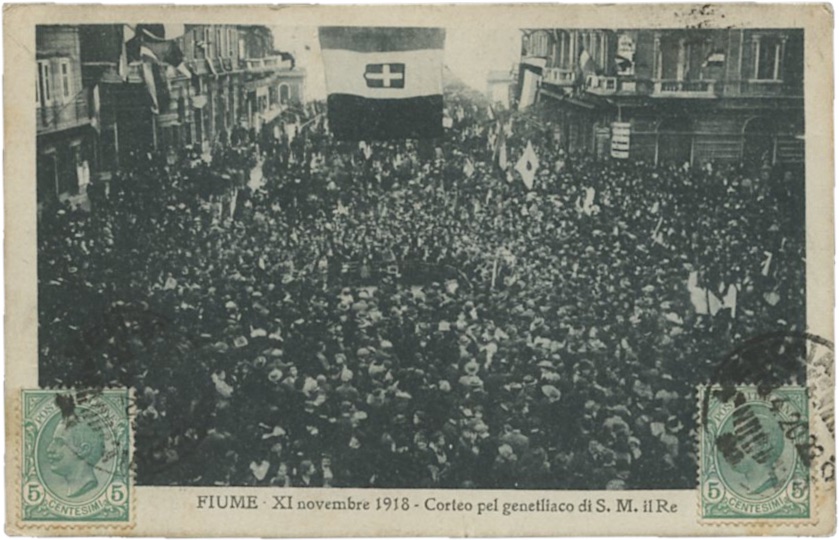
But this was only the beginning of aggressive Italian pressure. Abusing the pre-war censuses showing an “Italian majority”, local Italian nationalists founded their own Italian National Council in parallel and demanded immediate annexation to Rome.
Italy relied on the terms of the Armistice of Villa Giusti of 3 November 1918. Although the text of the armistice did not mention Rijeka at all (the city was not part of the territory the Allies had promised Italy in the Treaty of London), it gave the victors the right to occupy strategic points to maintain order. Under heavy Italian pressure the international high command capitulated. As early as 17 November 1918 the Serbian army, facing the threat of direct confrontation, had to withdraw across the Rječina to Sušak. Control of Rijeka passed to an inter-Allied occupation administration in which Italian royal troops completely dominated in numbers and politically, which opened the way to radicalisation.
D’Annunzio’s Terror and the Persecution of Autonomists
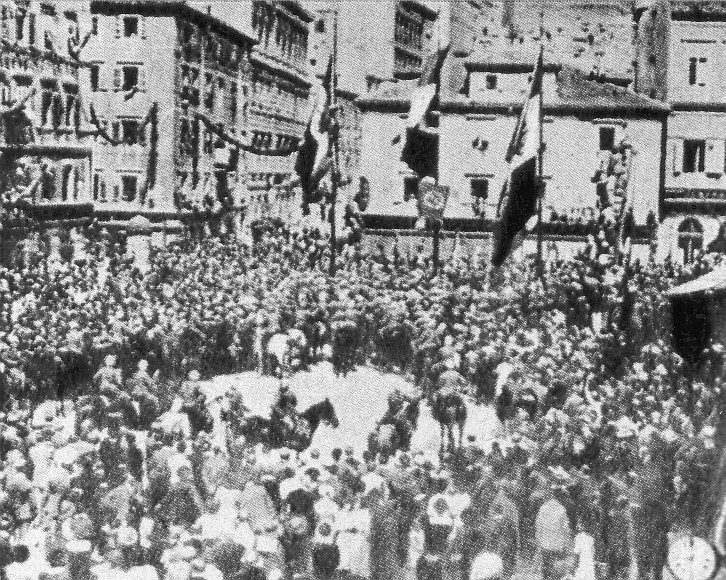
In September 1919 the Italian nationalist poet and adventurer Gabriele D’Annunzio marched on Rijeka with armed volunteers (legionaries). His self-proclaimed quasi-state, the Italian Regency of Carnaro (Reggenza Italiana del Carnaro), brought complete ideological terror and economic chaos to the city. Rijeka suffered from an international blockade and food shortages, while the legionaries carried out systematic violence against all opponents of annexation.
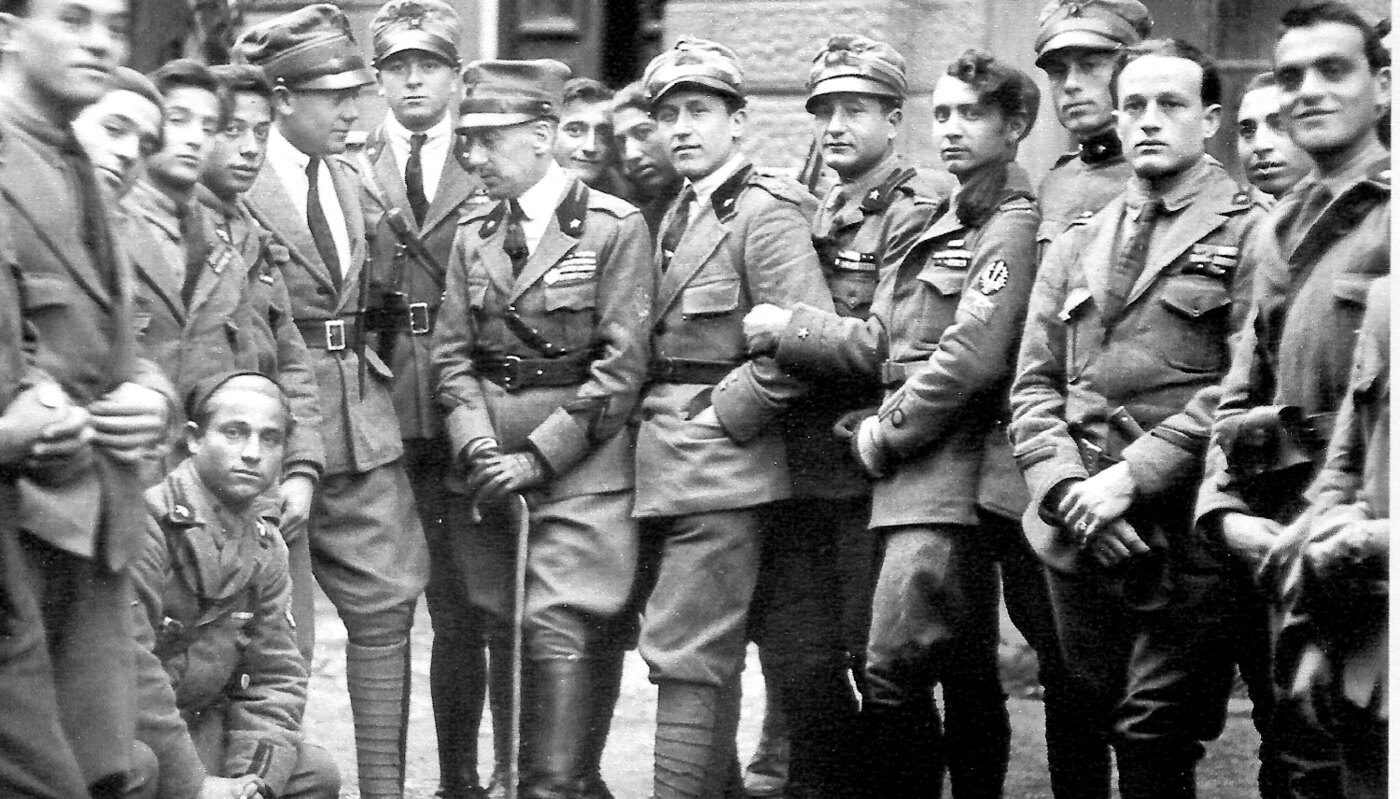
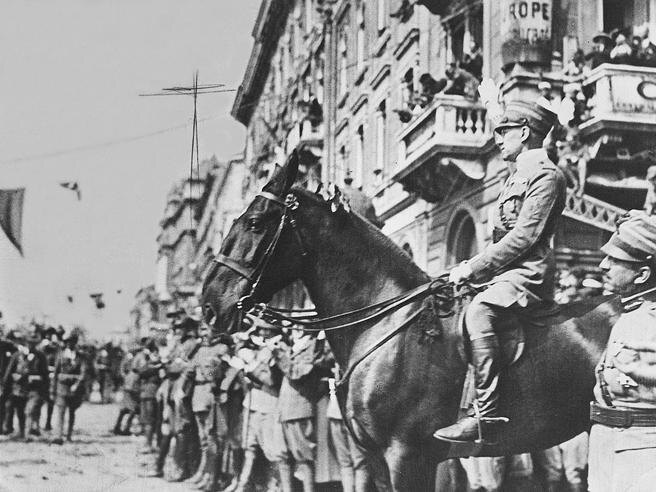
This terror was not aimed only at Croats and Slovenes, whose associations and language were banned, but just as brutally at the native Italian autonomists. These Rijeka Italians refused to submit to Rome and fought for an independent, multicultural Rijeka that would cooperate economically with the Yugoslav hinterland. To Italian nationalists these autonomists were “traitors to the race”, and so they were subjected to censorship, confiscation of property, beatings and expulsion from their own city.
Bloody Christmas and the Fascist Coup
In November 1920 Italy and the Kingdom of SCS signed the Treaty of Rapallo, agreeing that Rijeka would become an independent Free State of Fiume. Because D’Annunzio refused to recognise the treaty, the official Italian government sent regular troops (land forces and the navy) under General Enrico Caviglia in December 1920. These clashes, in which dozens of people died, entered history as “Bloody Christmas” (Natale di sangue). D’Annunzio was defeated and left the city.
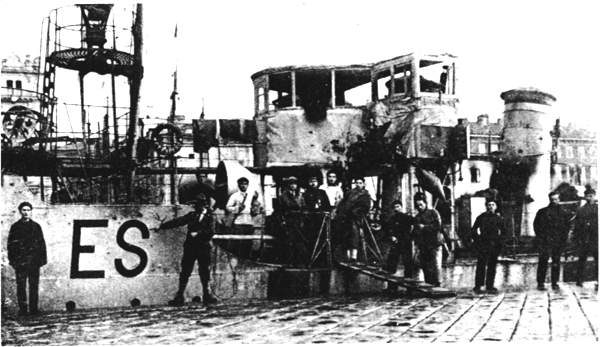
After his departure the regular Italian army temporarily took military control of the city as a guarantor of stability, while political control passed back to the Italian National Council. Under this military occupation the first democratic elections for the newly formed Free State of Fiume were held in April 1921. The inhabitants clearly expressed their will: the Autonomist Party under Riccardo Zanella, which advocated coexistence and independence, won convincingly.
But the attempt at democracy was quickly suppressed by force. Italian nationalists and local fascist gangs refused to recognise the election result. In March 1922, with the tacit support of Italian military circles, they carried out a violent coup. They attacked the government palace and forced Zanella into exile in Sušak (in Kraljevica). The state sank once more into administrative chaos and financial collapse.
The Final Abolition of Rijeka’s Independence
The last act of this planned abolition of Rijeka’s identity came after Benito Mussolini took power in Rome. In September 1923 he exploited the complete lack of government in Rijeka and sent General Gaetano Giardino to the city, who as military governor assumed dictatorial powers under the pretext of restoring order. This was the de facto end of Rijeka’s independence.
The Free State of Fiume was officially abolished, which began the years of the harshest fascist denationalisation, in which every Slavic pulse and Rijeka’s autonomist tradition was finally banned and persecuted. The Rapallo border thus extended after 1924 all the way to the Adriatic: the border line ran along the Rječina, which separated Rijeka from Sušak.
Timeline
| October 1918 | Collapse of Austria-Hungary; the National Council of SCS for Sušak and Rijeka takes power. |
| 3 November 1918 | Armistice of Villa Giusti. |
| 17 November 1918 | The Serbian army withdraws across the Rječina; Rijeka passes to an inter-Allied administration dominated by Italy. |
| September 1919 | D’Annunzio’s march on Rijeka. |
| 12 November 1920 | Treaty of Rapallo: Rijeka becomes an independent state. |
| December 1920 | Bloody Christmas: the Italian army and navy drive out D’Annunzio. |
| April 1921 | Elections: Zanella’s autonomists win. |
| March 1922 | Nationalist coup; Zanella in exile in Sušak. |
| September 1923 | Giardino as military governor. |
| 27 January 1924 | Treaty of Rome: Rijeka to Italy, Sušak and Baroš to the Kingdom of SCS. |