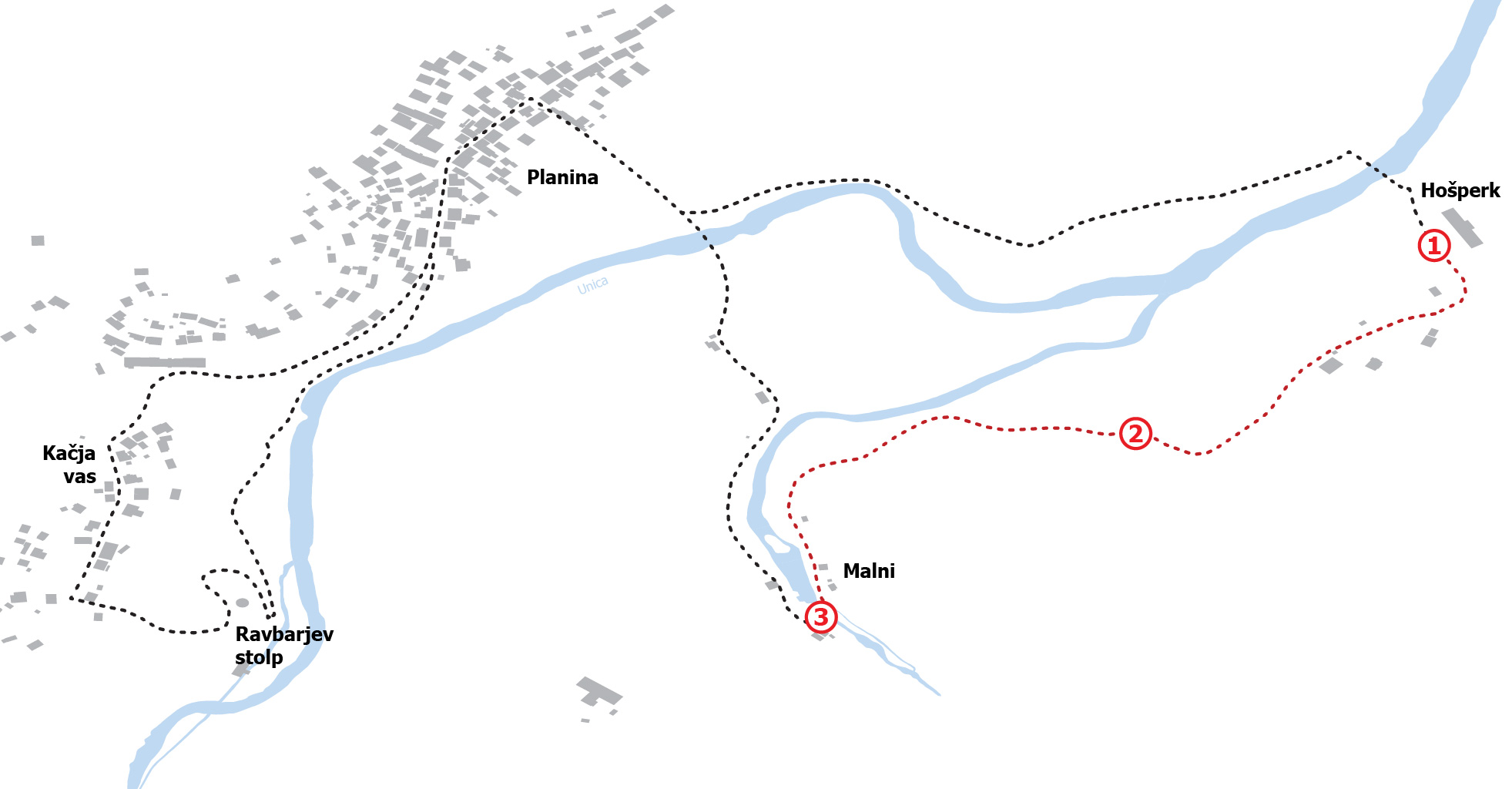
From the Hošperk manor towards the hamlet of Malni the Rapallo border ran in such a way that the road between them lay entirely on the Italian side of the border, and in Malni it even divided individual homesteads that stretched on both sides of the road. The bridge over the Malenščica creek thus belonged to the Italian side, beyond the bridge the border crossed the road and rose steeply up the nearby slope. The free flow of goods and people across the border in Malni was therefore of crucial importance; the locals crossed it on the road between two special markers. The permitted crossing was truly invaluable, since Malni lived above all from the mills and sawmills powered by the nearby springs.
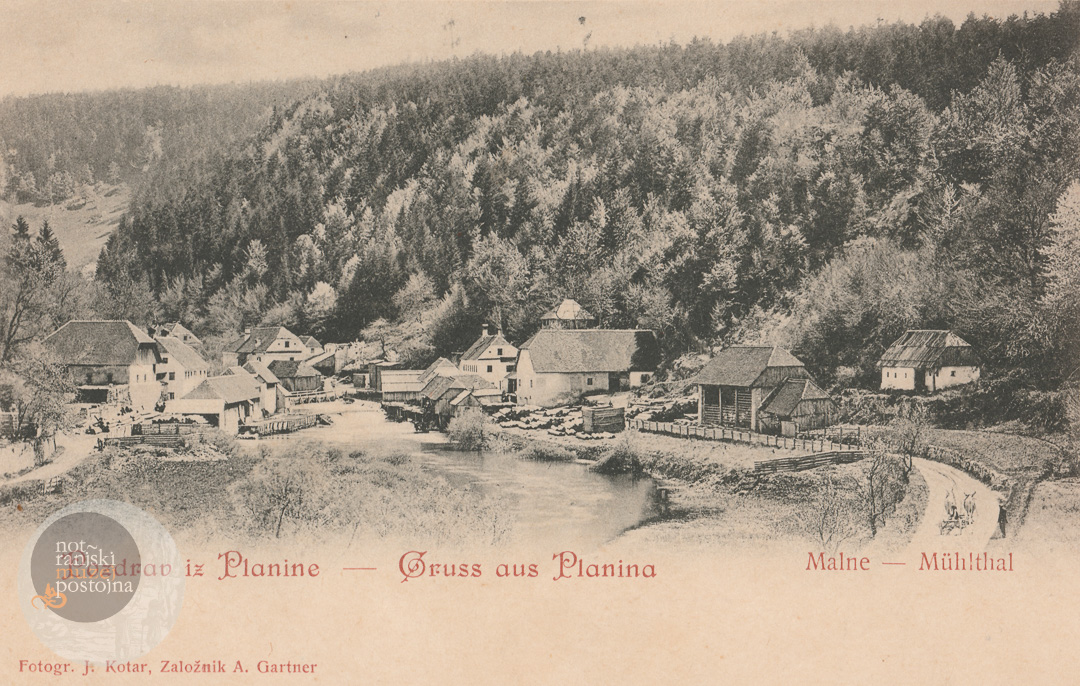
The population and seasonal labourers from the south of Italy, employed at favourable rates by the prince of the Hošperk manor — between the wars up to 500 people lived in what is now nearly empty Malni — carted timber from Planina to the sawmills for charcoal-making. This was only possible along the road past the manor, except during the regular floods of the Planinsko polje, when the border markers were submerged.
The locals repeatedly asked the members of the Mixed Border Commission to set the border in a way that made daily life possible and did not cut off access to the mills and sawmills. The Italian half of the commission — also at the request of the prince — refused to give way; in 1925 the two states accepted the proposal to divide Malni.
The road from Planina to Malni went entirely to Yugoslavia, the road from Malni to Hošperk to Italy. With this the prince gained, besides the manor itself, his sawmill and the road to it. The inhabitants of Planina gained one of only three special customs arrangements along the Rapallo border: the right to transport goods to Malni duty-free. The two states confirmed this right in their later economic agreements.
Today the appearance of Malni is somewhat different — the once imposing homesteads, the many mills and sawmills are gone. Besides a few abandoned houses, only the overgrown foundations of the former farm buildings remain. Malni, for more than 300 years an economic backbone of the Planinsko polje, is today empty.


1925 — On 19 July at 12 o'clock the corrected border line came into effect in the area of Kalce–Planina–Unec–Stražnik (near Rakek), with minor adjustments. The authorities of the Kingdom of SHS took over the border positions in Planina and at Malni, the Italians took over the Hošperk manor. The Italian side gave up 16 houses in Grčarevec, 12 houses in Gorenja Planina, 4 houses in Liplje and 4 houses at Malni. Even the corrected demarcation was not entirely adapted to the actual situation on the ground — the house of the landowner Janez Modrijan from Malni 6 stayed in Italy, while his sawmill and mill stayed in the Kingdom of SHS.
In October a tragic border incident also occurred — a car of the demarcation commission of the Kingdom of SHS ran over a child to death in Planina; the state covered the funeral costs.1976 — During the construction of the water-catchment area, locals managed to preserve two large markers. They did so by moving them and using them as posts of the fence around the water-catchment area, while also rotating them; as a result, the letters I and J — which mark the side of the border line that the face is turned towards — are today on the wrong sides.