
The strategic importance of the most favourable connection between the Po valley and the wide plains of the Danube — the Postojna Gate — was already recognised in prehistory, as numerous archaeological finds attest. The remains of the Roman defensive systems at Hrušica, the imposing Ravbarjev stolp and the ruins of the Stari grad above Hošperk (Haasberg) only confirm millennia of efforts to control the pass, whose northern side at the edge of the Planinsko polje is marked by the elongated outline of Planina.
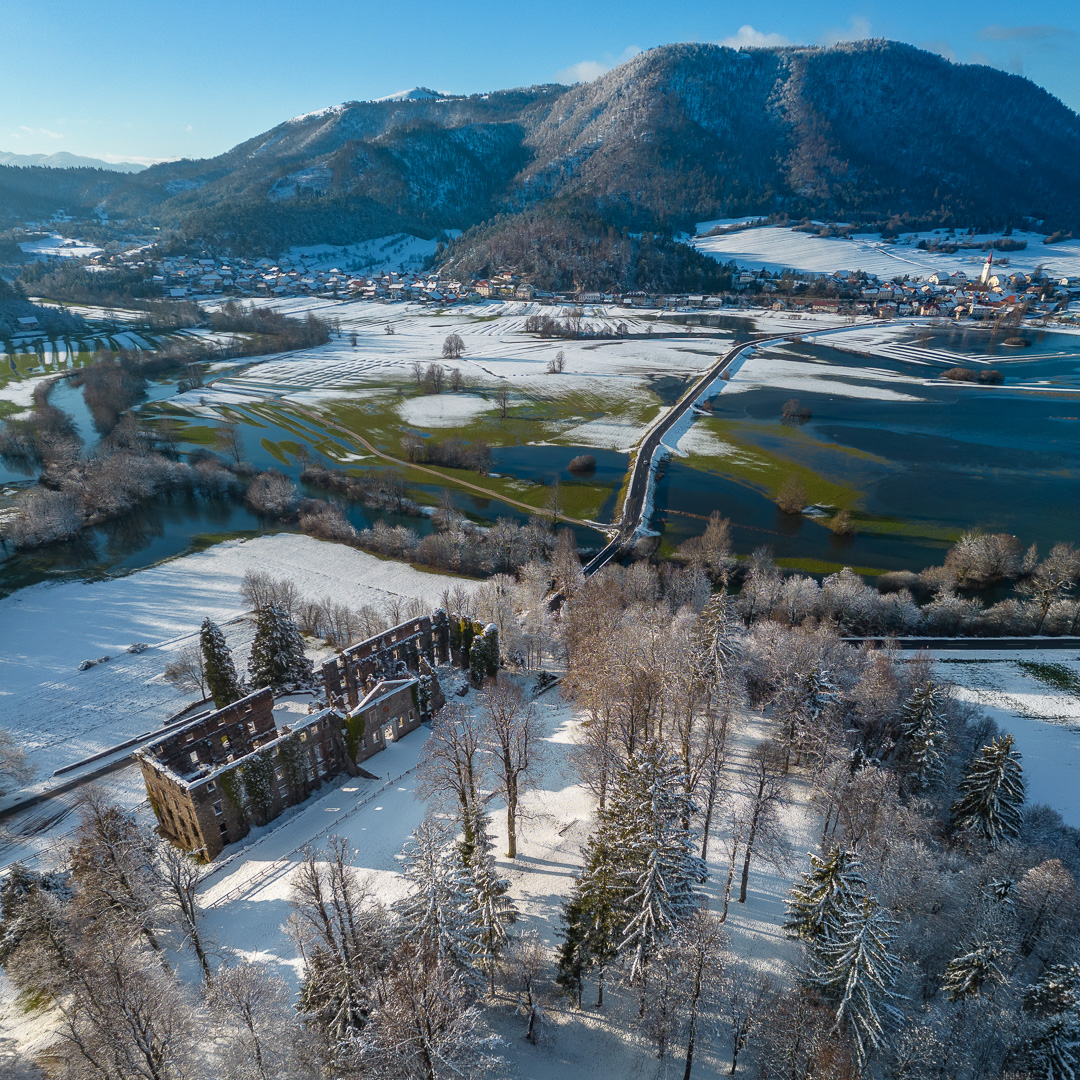
The manor is built on a low terrace beneath Zajčji hrib, as locals once called the 703 m solitary peak between Rakov Škocjan and the Planinsko polje. The hill's importance is shown by the succession of a hillfort, a Roman outpost, and in the Middle Ages (first mentioned in the 13th century) the original castle Haasberk (Hošperk). From the German name Haas we can infer that this is a translation of Zajčji hrib (Zajec — Hase).
The castle was destroyed in the earthquake of 1509. The Eggenberg family, which owned it, chose not to rebuild on the same spot but instead built a new castle at the foot of the hill.
In 1716 Maria Eggenberg sold Hošperk to the important Austrian diplomat Johann Caspar Cobenzl. On the site of the existing castle, that family built a magnificent new Baroque manor with a landscaped park. In 1846 the estate passed into the hands of the Counts Windischgrätz, who further enriched the manor and its park. The manor was burned down in March 1944 and has been slowly decaying ever since. Its ruins have been declared a cultural monument of local importance by the municipality of Postojna.
The manor was visited by Emperor Franz Joseph I. He visited Notranjska (Inner Carniola) in 1857, the year the Vienna–Trieste railway opened, twice in 1864, and again almost twenty years later in 1883.
The manor enjoyed excellent transport connections for its time, as the Rakek railway station was only five kilometres away.

The end of the World War and the Italian occupation
Although the system of alliances drew most European countries into the war, Italy initially remained neutral. Under the pretext of liberating Italian-speaking areas, it in fact sought to acquire German-, Slovene-, and Croatian-speaking territories in Tyrol, the Littoral, and Dalmatia. After the failures of Austria-Hungary in the first year of the war, Italy perceived an opportunity to seize those territories and therefore chose to enter the conflict. By attacking Austria-Hungary in 1915, Italy broke its pre-war agreements and, in return for joining the Entente, secured the secret Treaty of London. In it, Italy was promised, among other things, the Slovene lands of Austria-Hungary.
In the prince's vast forests, labour settlements for woodcutters quickly grew — the army's demand for timber was enormous. A narrow-gauge railway was even built between the Pivka railway station and the forest houses at Otoška and Jurjeva dolina in the Javorniki, to transport timber. More on the Park vojaške zgodovine (Military History Park).
The successful 12th Soča offensive of 1917 promised an end to the war, but the fighting flared up again along the river Piave. A year later, owing to national movements, general shortages, and the failure of reforms, Austria-Hungary began to disintegrate. The Czechs and Slovaks were the first to declare independence; the very next day the Slovenes, Croats and Serbs in the Austria-Hungary followed. The Italian army seized the opportunity and used the army's collapse to launch its own offensive eastward.
On 3 November 1918, Austria-Hungary signed an armistice and accepted the Entente forces' occupation of the area between the Julian Alps and Rijeka (CRO). The Slovenes, by then united in the State of Slovenes, Croats and Serbs (SHS), could only watch helplessly as the Italians occupied territories. Postojna, Planina, Rakek and even Logatec found themselves in occupied territory, and as early as December 1918 the Italian army unilaterally — and in breach of the Geneva Convention — imposed Italian inscriptions, place names and administration. The "temporary" occupation was understood as final, regardless of the ethnic composition of the territory.


The unjust Rapallo border treaty
On 1 December 1918, just over a month after its founding, the State of SHS and the Kingdom of Serbia merged into the Kingdom of Serbs, Croats and Slovenes (SHS). The new kingdom, most of whose borders were still unresolved, placed great hopes in the outcome of the peace conference, but the two states were ultimately forced to settle the disputed border themselves.
On 12 November 1920 the representatives of the two states signed the border treaty, and apart from a portion of Notranjska, Italy obtained all its demands and even exceeded the promises made to it in London in 1915. The withdrawal of the Italian army and state services from Planina took place on 27 February 1921. The hand-over of the area, and the special train on which the members of the border commission led by general Maister arrived in Logatec and Rakek, are described in a separate article.

"The liberation of Planina", as the newspapers of the day called the Italian withdrawal, was only the beginning of nearly four years of careful demarcation of the border line. Between 1921 and 1925 both Planina and the Hošperk manor were under the Kingdom of SHS, which did not suit the prince — who haggled over the advantages and drawbacks of belonging to one state or the other. The Italians bought the prince's goodwill above all by not threatening to confiscate his estates. The Kingdom of SHS, on the other hand, appointed state administrators for most large landowners' estates. Prince of Windisch-Grätz therefore concluded it was better for him that as much as possible should go to Italy, and in 1925 he succeeded in having the border line changed so that the manor was awarded to Italy, but the border encircled it on three sides. At the junction with the main road, by the bridge over Unica, the two states later established a small border crossing so that the manor's employees — most of whom lived in Planina — could continue to come to work undisturbed.
Border passes and the passport
Before border crossings and small-border-traffic passes were set up, residents living along the border had to present, in addition to a passport, a permit each time they crossed the temporary demarcation line. "Social reliability" was also a criterion when issuing permits — the mayor of the municipality of Logatec, for example, vouched for the good name of Princess Leotine Windischgrätz, whose passport is preserved today at the Archives of the Republic of Slovenia.

